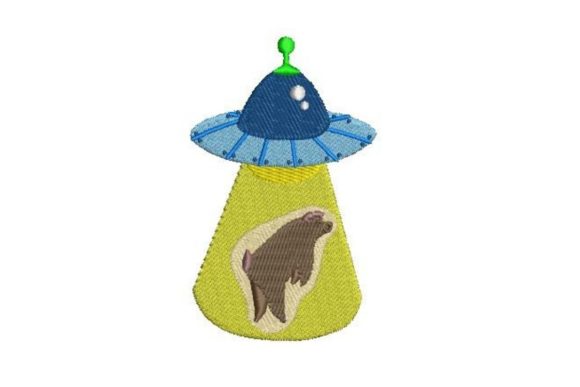
UFO Abducting a Bear
A Playful, Punchy Design That Demands the Right Context
First impression? UFO Abducting a Bear lands with cheerful irreverence—equal parts sci-fi wink and woodland whimsy. It’s not subtle, and it shouldn’t be. The composition balances bold negative space with clear focal points: the saucer-shaped UFO, the wide-eyed bear mid-lift, and just enough visual storytelling to spark a smile without needing explanation. As a machine embroidery design, it leans into cartoon clarity—not photorealism—so details like the bear’s paws, UFO beams, or tiny antenna are simplified but intentional. That’s good news for stitch reliability, especially on apparel.
Where It Shines: Real Projects, Real Reactions
Last week, I prepped a small-batch run of organic cotton tote bags for a local indie bookstore’s “Weird & Wonderful” summer promotion. UFO Abducting a Bear was the centerpiece. Stitched at 4.2" wide on the front pocket, it held up beautifully—clean satin stitch edges on the UFO rim, consistent fill stitch in the bear’s body, and just enough running stitch for subtle texture in the beam. Customers paused, pointed, laughed. One even asked if the bear was *willing*. That’s the power of this design: it invites interaction, not just observation.
It also worked well as a sweatshirt embroidery on midweight fleece—no puckering, no thread breakage—when paired with medium-weight cutaway stabilizer. On baby onesies? I’d size it down to ~3", use lightweight tear-away, and skip any dense fill areas near seams. For embroidered patches, it’s ideal: crisp outlines, minimal underlay, and strong silhouette recognition even at 2.5". As a holiday embroidery on a linen tea towel? Yes—but place it away from hems and high-friction zones. The humor reads instantly, making it a standout small shop product for craft fairs or Etsy listings targeting playful, design-savvy buyers.
Where to Pause—and Why
This isn’t a one-size-fits-all embroidery file. On thin or stretchy fabrics like jersey or rayon challis, the design’s moderate stitch density can cause distortion if stabilizer isn’t precisely matched. I tested it on a curved cap front and found the upper arc of the UFO slightly compressed—fine for casual wear, less ideal for premium boutique branding. Dark fabric demands careful thread color selection: light gray or pale yellow thread on black gives clarity without glare; white thread risks haloing in dense fills. And while the bear’s face has charm, its small eyes and mouth rely on clean satin stitch—test those on scrap first. If your machine struggles with tight corners or short jump stitches, you may see minor nesting or thread pulls.
Also worth noting: the design belongs squarely in the Robots category by theme, but functionally, it’s pure Embroidery—not an applique design. There’s no raw-edge fabric layering, no layered placement steps. That simplifies production for Etsy sellers juggling dozens of digital embroidery file orders, but it also means visual impact relies entirely on stitch execution, not material contrast.
What It Adds (and Doesn’t Add) to Your Finished Product
UFO Abducting a Bear elevates handmade product appeal through personality—not polish. It won’t make a generic t-shirt look “luxury,” but it *will* make a custom apparel piece feel intentionally joyful and memorable. For personalized gifts, that’s gold: parents ordering baby embroidery for a nursery-themed shower loved how it balanced sweetness and silliness. For craft business owners, it strengthens brand consistency when used across matching pillow covers, aprons, and kitchen towels—same tone, same recognizable motif.
But don’t mistake memorability for universality. It won’t resonate with minimalist buyers or formal gifting audiences. Its strength is specificity: it attracts the right people, not everyone. That actually builds customer trust—shoppers know exactly what vibe they’re choosing. And because it’s visually distinct, it performs well in printable mockups and digital product previews, helping Etsy sellers convert faster than with generic floral or script designs.
Designer Notes You’ll Actually Use
- Always test first: Run UFO Abducting a Bear on scrap fabric matching your final project’s weight, weave, and stretch—even if it’s just a corner swatch.
- Check thread colors against background: Try it in black-and-white mockups too. Some contrasts vanish on screen but pop in real life (and vice versa).
- Review stitch density: Zoom into the UFO’s underside and the bear’s ear in your embroidery software. Look for over-stitched zones that could cause stiffness or cracking after washing.
- Confirm hoop size early: This design fits comfortably in a 5x7 hoop, but double-check your file’s exact dimensions before digitizing adjustments.
- Stabilizer matters more than you think: Cutaway for knits, tear-away for stable wovens, and avoid topping unless testing shows fiber show-through on textured fabric.
- Licensing check is non-negotiable: Since this is a commercial embroidery file, verify whether resale of finished products (e.g., embroidered tote bags) or redistribution of the digital embroidery file is permitted.
Final Thought: Humor Has Texture—So Should Your Embroidery
UFO Abducting a Bear works because it respects both the craft and the customer. It doesn’t ask for perfection—it asks for playfulness, precision, and thoughtful placement. Whether you’re stitching it onto a holiday gift, scaling it for a boutique apron line, or bundling it as part of a digital embroidery file collection, it rewards attention to detail and context. It’s not background decor. It’s a conversation starter stitched in thread. And in a market crowded with safe, scalable designs, that kind of confident, character-driven work is exactly what makes handmade product stand out—without saying a word.